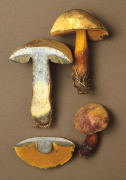
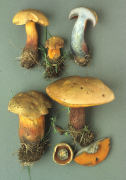
Boletus luridus Schaeff. ex Fr. Netzstieliger Hexenröhrling Bolet blafard Lurid Bolete Cap 6–14cm, snuff brown or olive brown with rusty or bay tints, slightly downy at first then becoming smooth and polished, bruising dark brownish or blue-black. Stem 80–140 x 10–30mm yellowish red with orange-red net, bruising blue. Flesh lemon-yellow in cap soon becoming greenish-blue to dark blue on cutting with a persistent red line above tubes, lemon in stem and blackish-red in stem base. Taste and smell not distinctive. Tubes yellowish-green, blue on cutting. Pores small, orange-red, more yellow at margin, bruising dark blue. Spore print olivaceous snuff-brown. Spore subfusiform to broadly ellipsoid, 11–15 x 4.5–6.5µ. Habitat in broad-leaved woods, particularly with oak or beech and on calcareous soils. Season summer to autumn. Occasional. Edible when cooked, but has been known to cause gastric upsets. (Two forms illustrated.) Distribution, America and Europe. |